Receiving your child’s report card is an important part of being involved in their education. However, understanding your child’s report card can sometimes be challenging, especially if English is not your first language or you are new to the Canadian school system.
A report card provides information about your child’s academic progress, learning skills, classroom participation, and areas that need improvement. It also helps parents understand what their children are doing well and how they can support their learning at home.
In Canada, report cards look different depending on the province, school board, and grade level. In Ontario, for example, there are some important differences between elementary (primary) and secondary school report cards.
In this article, you will learn essential vocabulary related to report cards, understand common teacher comments, and discover the differences between elementary and secondary school reporting.
1. Primary (Elementary) vs. Secondary School Report Cards
In Ontario, the school system is generally divided into two main levels:
- Elementary school (primary school): Grades 1–8.
- Secondary school (high school): Grades 9–12.
Although both report cards provide information about academic achievement and learning skills, they are organized differently.
Elementary (Primary) School Report Cards – Grades 1–8
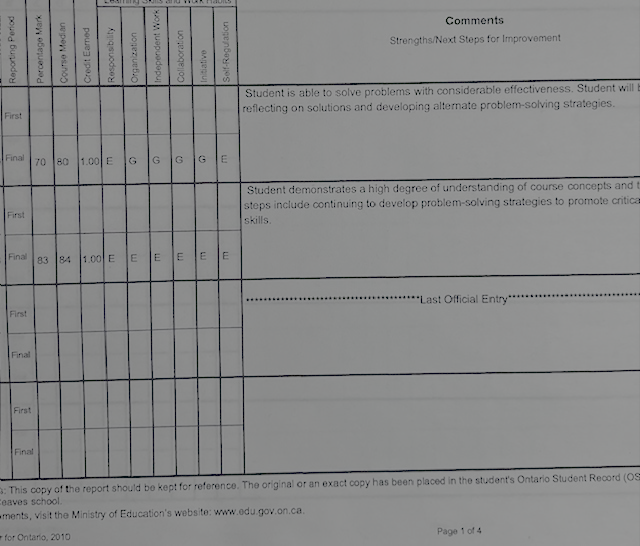
Elementary report cards focus on your child’s development in different subjects and learning skills.
What information can you find?
- Subjects: Language, Mathematics, Science and Technology, Social Studies, and other subjects.
- Grades: Students in Grades 1–6 receive letter grades (A, B, C, D), while students in Grades 7–8 receive percentage marks.
- Learning skills: Teachers evaluate responsibility, organization, independent work, collaboration, initiative, and self-regulation.
- Teacher comments: Teachers describe your child’s strengths and areas for improvement.
- Next steps: Suggestions about what your child should practise or improve.
In Ontario, elementary students usually receive three formal reports during the school year: a fall progress report and two provincial report cards.
The fall progress report does not include letter grades or percentage marks for academic subjects. Instead, teachers indicate whether students are progressing very well, well, or with difficulty.
Secondary (High School) Report Cards – Grades 9–12
Secondary school report cards provide more detailed information about individual courses and academic performance.
What information can you find?
- Courses: A list of subjects your teenager is taking, such as English, Mathematics, Biology, History, and Geography.
- Percentage marks: Each course receives a numerical grade, such as 65%, 78%, or 92%.
- Credits: Information about credits earned toward the Ontario Secondary School Diploma (OSSD).
- Learning skills: An evaluation of your child’s responsibility, organization, independent work, collaboration, initiative, and self-regulation.
- Teacher comments: Feedback about academic performance, participation, and areas for improvement.
- Attendance: Information about absences and late arrivals.
- Course median: The middle mark in the course, which helps students compare their mark with the overall class results.
Unlike elementary school, secondary school is organized around individual courses. Students must successfully complete the required courses and earn the necessary credits to graduate.
Quick Comparison: Elementary vs. Secondary Report Cards
| Information | Elementary (Grades 1–8) | Secondary (Grades 9–12) |
|---|---|---|
| Academic subjects | Subjects such as Language, Math and Science | Individual courses such as English, Biology and History |
| Grades | Letter grades in Grades 1–6; percentages in Grades 7–8 | Percentage marks |
| Learning skills | Evaluated | Evaluated |
| Teacher comments | Strengths and next steps | Academic feedback and suggestions |
| Credits | Not normally reported as high school credits | Credits earned toward graduation |
| Attendance | Absences and late arrivals | Absences and late arrivals, often by course |
| Reporting periods | Three formal reports per year | Depends on semesters and school schedule |
2. Essential Vocabulary: Understanding a Report Card
Here are some common words and expressions you may see on your child’s report card.
| Vocabulary | Simple Definition |
|---|---|
| Report card | A school document showing a student’s progress and achievement. |
| Academic achievement | How well a student has learned the required knowledge and skills. |
| Progress | Improvement or development over time. |
| Grade | A letter or number showing a student’s achievement. |
| Percentage mark | A grade expressed as a number out of 100. |
| Learning skills | Skills that help students become successful learners. |
| Work habits | Behaviours and routines that help students complete their schoolwork. |
| Strengths | Things your child does well. |
| Areas for improvement | Skills or subjects that your child needs to develop. |
| Next steps | Actions or goals to help your child improve. |
| Feedback | Comments or suggestions about a student’s performance. |
| Achievement | Something a student has successfully learned or accomplished. |
| Curriculum expectations | The knowledge and skills students are expected to learn. |
| Assessment | The process of gathering information about student learning. |
| Evaluation | Judging the quality of a student’s learning based on evidence. |
3. Understanding Learning Skills and Work Habits
In Ontario, teachers evaluate six important learning skills and work habits in both elementary and secondary schools.
These skills are important because academic success involves more than getting good grades. Students also need to develop positive behaviours, independence, and responsibility.
| Learning Skill | Simple Definition | Example |
|---|---|---|
| Responsibility | Being accountable for your actions and duties. | Your child completes homework and submits assignments on time. |
| Organization | Planning and managing time and materials. | Your child keeps school supplies organized and follows a study schedule. |
| Independent Work | Working without constant help from others. | Your child completes classroom activities independently. |
| Collaboration | Working well with other people. | Your child shares ideas and participates in group projects. |
| Initiative | Showing interest and taking action without always being asked. | Your child volunteers to answer questions or tries new activities. |
| Self-Regulation | Managing emotions, behaviour, and learning. | Your child stays focused, sets goals, and asks for help when needed. |
What Do the Learning Skills Grades Mean?
In Ontario, teachers use the following letters to evaluate learning skills and work habits:
| Grade | Meaning |
|---|---|
| E | Excellent |
| G | Good |
| S | Satisfactory |
| N | Needs Improvement |
Example:
If your child’s report card shows:
- Responsibility: E
- Organization: G
- Independent Work: S
- Collaboration: E
- Initiative: G
- Self-Regulation: N
This means your child demonstrates excellent responsibility and collaboration but needs to improve self-regulation.
Remember: Learning skills are evaluated separately from academic grades. A student can achieve excellent academic marks but still need to improve their organization or independent work habits.
4. Common Teacher Comments and Their Meanings
Teachers often write comments to explain a student’s progress. Understanding these expressions can help you identify what your child is doing well and what needs attention.
| Teacher Comment | What It Means |
|---|---|
| Demonstrates a good understanding of the subject. | Your child understands the material being taught. |
| Consistently completes assignments on time. | Your child regularly finishes and submits work before the deadline. |
| Participates actively in classroom discussions. | Your child contributes ideas and answers questions. |
| Works well independently. | Your child can complete tasks without much assistance. |
| Shows enthusiasm for learning. | Your child is interested and excited about learning. |
| Needs to improve time management. | Your child should learn to use time more effectively. |
| Would benefit from additional practice. | Your child needs more opportunities to practise certain skills. |
| Needs to pay closer attention to instructions. | Your child should listen carefully and follow directions. |
| Should participate more frequently. | Your child is encouraged to share ideas and contribute more often. |
| Is making steady progress. | Your child is gradually improving. |
| Needs additional support in reading comprehension. | Your child needs help understanding what they read. |
| Is encouraged to take more initiative. | Your child should try to take action and complete tasks without always waiting for instructions. |
5. Important Vocabulary for Secondary School Report Cards
When your child starts high school, you may notice new terms related to courses, graduation, and academic requirements.
| Vocabulary | Simple Definition |
|---|---|
| Course | A subject that a student studies during a semester or school year. |
| Credit | A unit earned after successfully completing a high school course. |
| Semester | One of two main periods in a school year. |
| Midterm report | A report showing a student’s progress around the middle of a course or semester. |
| Final mark | The overall grade a student receives at the end of a course. |
| Prerequisite | A course or requirement that must be completed before taking another course. |
| Course median | The middle percentage mark among students taking the same course. |
| Graduation requirements | The courses, credits, and other requirements students must complete to graduate. |
| Academic performance | How well a student is doing in their courses. |
| Postsecondary education | Education after high school, such as college or university. |
| Compulsory course | A course that students are required to complete. |
| Elective course | A course students can choose based on their interests and goals. |
| Attendance | The record of a student’s presence at school or in class. |
| Absence | A time when a student does not attend school or class. |
| Late arrival | Arriving after the class or school has started. |
6. Useful Expressions for Talking to Your Child’s Teacher
If you have questions about your child’s report card, you can contact the teacher or arrange a parent-teacher meeting.
Here are some useful expressions:
Asking about academic progress:
- Could you explain my child’s grade in Mathematics?
- Is my child meeting the curriculum expectations?
- What subjects does my child find most challenging?
- Has my child made progress since the last report card?
Asking about learning skills:
- How can my child improve their organizational skills?
- Does my child participate in classroom activities?
- Is my child able to complete assignments independently?
- What can we do at home to develop better study habits?
Asking about next steps:
- What should my child focus on improving?
- Are there any additional resources you would recommend?
- Does my child need extra support in any subject?
- How can I support my child’s learning at home?
7. What Should You Do After Receiving Your Child’s Report Card?
A report card is not just a document showing grades. It is an opportunity to understand your child’s learning and work together with the school to support their development.
Here are four practical steps:
- Celebrate your child’s strengths. Recognize their achievements, effort, and progress.
- Discuss areas for improvement. Talk about challenges in a positive and supportive way.
- Set realistic goals. Choose one or two skills your child can work on before the next report card.
- Communicate with the teacher. Ask questions if you do not understand a comment or are concerned about your child’s progress.
Remember, every child learns at a different pace. A report card should help you understand your child’s development, identify their needs, and plan the next steps together.
Key Vocabulary Review
Before you finish, review these ten important words:
- Achievement – Something successfully learned or accomplished.
- Progress – Improvement over time.
- Feedback – Comments or suggestions about performance.
- Strengths – Things someone does well.
- Improvement – The process of becoming better.
- Responsibility – Being accountable for your actions.
- Collaboration – Working together with others.
- Initiative – Taking action without always being asked.
- Self-regulation – Managing your emotions, behaviour, and learning.
- Prerequisite – Something that must be completed before moving to the next step.
English Learning Tip: When you receive your child’s report card, try reading the teacher’s comments in English. Highlight unfamiliar words, look up their meanings, and practise using them in sentences. This is a great way to improve your English while becoming more familiar with the Canadian education system.
Practice
Exercise 1: Match the Vocabulary
Match each word with its correct definition.
| Word | Definition |
|---|---|
| 1. Achievement | A. Working together with others |
| 2. Feedback | B. Something a student has successfully learned |
| 3. Collaboration | C. Comments or suggestions about performance |
| 4. Responsibility | D. Managing your actions and duties |
| 5. Progress | E. Improvement over time |
| 6. Initiative | F. Taking action without being asked |
Exercise 2: Choose the Correct Answer
Choose the best answer for each question.
1. What does “areas for improvement” mean?
A. Things your child does very well.
B. Skills your child needs to develop.
C. Subjects your child does not study.
D. Activities your child enjoys.
2. If a teacher says, “Your child works well independently,” what does it mean?
A. Your child prefers to work with friends.
B. Your child needs help with every activity.
C. Your child can complete tasks without much help.
D. Your child does not complete assignments.
3. What does “prerequisite” mean in high school?
A. A final examination.
B. A course that must be completed before taking another course.
C. A school holiday.
D. A student’s final mark.
4. What does a learning skills grade of N mean in Ontario?
A. Needs Improvement.
B. Not Available.
C. New Student.
D. No Assessment.
5. What is a credit in secondary school?
A. Money given to students.
B. A mark on a report card.
C. A unit earned after successfully completing a course.
D. A teacher’s comment.
Exercise 3: Understand the Teacher’s Comments
Read the following comments and answer the questions.
Situation A: Elementary School
Your child’s Grade 5 teacher writes:
“Sarah demonstrates a good understanding of Mathematics. She participates actively in classroom discussions and works well with other students. However, she needs to improve her organizational skills and submit assignments on time.”
Answer the questions:
- Which subject does Sarah understand well?
- What does Sarah do well in the classroom?
- What two areas does she need to improve?
- What does “submit assignments on time” mean?
Situation B: Secondary School
Your teenager’s Grade 10 teacher writes:
“David has demonstrated steady progress in English. He understands the main ideas of reading passages but needs to develop his writing skills. He is encouraged to participate more frequently in classroom discussions and manage his time more effectively.”
Answer the questions:
- Which subject is David studying?
- What has he demonstrated?
- Which skill does he need to develop?
- What does the teacher encourage him to do?
- What does “manage his time more effectively” mean?
Exercise 4: Primary or Secondary?
Decide whether each word or expression is more commonly associated with an elementary school report card, a secondary school report card, or both.
Write:
- E = Elementary
- S = Secondary
- B = Both
- Percentage marks
- Learning skills
- Course credits
- Responsibility
- Prerequisites
- Teacher comments
- Semester
- Collaboration
- Graduation requirements
- Areas for improvement
Exercise 5: Complete the Sentences
Use the words in the box to complete the sentences.
Word Bank:
achievement | feedback | progress | responsibility | collaboration | prerequisite
- My daughter’s teacher gave us positive __________ about her reading skills.
- Completing homework on time shows __________.
- Students need to work together during group activities. This is called __________.
- My son has made good __________ in Mathematics this year.
- Passing Grade 9 English may be a __________ for another course.
- Receiving a high mark is an example of academic __________.
Exercise 6: Practise Speaking
Imagine that you are attending a parent-teacher meeting after receiving your child’s report card.
Practise answering these questions:
- How do you feel about your child’s academic progress?
- Which subjects does your child enjoy the most?
- Are there any subjects your child finds difficult?
- What learning skills would you like your child to improve?
- How do you support your child’s learning at home?
Useful Expressions:
- I am pleased with my child’s progress.
- I am concerned about my child’s performance in Mathematics.
- Could you explain this teacher comment?
- What can we do to improve these skills?
- I would like to know how my child is doing in class.
Exercise 7: Write an Email to Your Child’s Teacher
Writing Challenge
You have received your child’s report card. You notice that your child needs improvement in reading comprehension and organization.
Write an email to the teacher. In your email:
- Thank the teacher for the report card.
- Ask for more information about your child’s reading skills.
- Ask how your child can improve organizational skills.
- Ask for suggestions about activities you can do at home.
Useful Vocabulary: progress, improvement, reading comprehension, organization, feedback, support.
Answer Key
Exercise 1: 1-B, 2-C, 3-A, 4-D, 5-E, 6-F.
Exercise 2: 1-B, 2-C, 3-B, 4-A, 5-C.
Exercise 3:
Situation A:
- Mathematics.
- Participating in discussions and working with other students.
- Organization and submitting assignments on time.
- Handing in schoolwork before the deadline.
Situation B:
- English.
- Steady progress.
- Writing skills.
- Participate more in discussions and manage his time better.
- Use time more wisely and complete tasks within deadlines.
Exercise 4: 1-B, 2-B, 3-S, 4-B, 5-S, 6-B, 7-S, 8-B, 9-S, 10-B.
Exercise 5: 1. feedback, 2. responsibility, 3. collaboration, 4. progress, 5. prerequisite, 6. achievement.