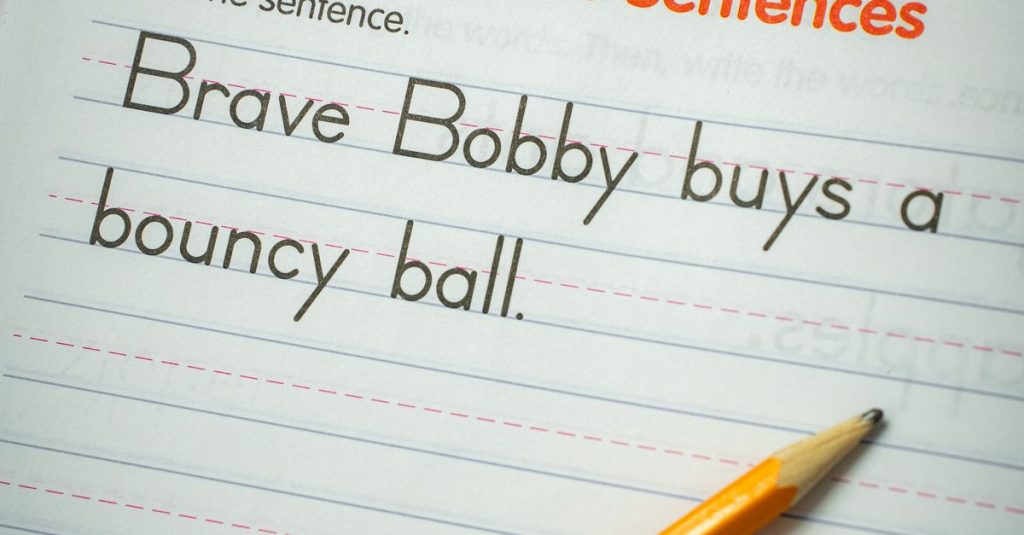
Good writing starts with good sentences. If you understand simple sentence patterns in English, you can speak and write more clearly. Every English sentence follows a pattern. Learning these patterns will help you write emails, messages, homework, as well as have everyday conversations with confidence.
In this lesson, you will learn five common sentence patterns with easy examples.
What Is a Sentence Pattern?
A sentence pattern is the order of words in a sentence. Most English sentences follow a predictable structure.
The most common parts of a sentence are:
- Subject (S) – the person, place, or thing.
- Verb (V) – the action or state.
- Object (O) – receives the action.
- Complement (C) – gives more information about the subject or object.
- Adverbial (A) – tells when, where, or how.
Examples
- Maria studies.
- Maria studies English.
- Maria is happy.
- Maria studies at the library.
Vocabulary
Subject – the person or thing doing the action.
Verb – an action or state.
Object – the person or thing receiving the action.
Complement – words that describe or rename.
Adverbial – words that tell when, where, or how.
Pattern 1: Subject + Verb (S + V)
This is the shortest complete sentence.
Structure
Subject + Verb
Examples
- Birds fly.
- The baby cried.
- We laughed.
- My friend arrived.
This pattern uses intransitive verbs, which do not need an object.
Vocabulary
Structure – the way something is organized.
Intransitive verb – a verb that does not need an object. For example: verb ‘arrive’ (‘They arrived home safely.’) is an intransitive verb.
Complete sentence – a sentence with a subject and a verb.
Pattern 2: Subject + Verb + Object (S + V + O)
Many verbs need an object to complete their meaning.
Structure
Subject + Verb + Object
Examples
- I read books.
- She loves her daughter.
- They play soccer.
- We watch television.
Ask What? or Whom? after the verb to find the object.
Vocabulary
Object – receives the action.
Meaning – what something expresses.
Receive – to get something.
Pattern 3: Subject + Verb + Complement (S + V + C)
Some verbs connect the subject to more information instead of an object.
Structure
Subject + Linking Verb + Complement
Examples
- He is tired.
- The soup smells delicious.
- They became friends.
- My teacher is kind.
Common linking verbs include:
- be
- become
- seem
- look
- feel
- smell
- sound
Vocabulary
Linking verb – connects the subject to information.
Complement – describes or renames the subject. Complements can be an adjectives or nouns.
Describe – to tell what someone or something is like.
Pattern 4: Subject + Verb + Adverbial (S + V + A)
Sometimes a sentence tells where, when, or how something happens.
Structure
Subject + Verb + Adverbial
Examples
- We live in Canada.
- She works every day.
- They arrived early.
- I study at home.
Adverbials answer questions like:
- Where?
- When?
- How?
- How often?
Vocabulary
Adverbial – tells where, when, or how.
Early – before the expected time.
Every day – each day.
Pattern 5: Subject + Verb + Object + Object (S + V + O + O)
Some verbs take two objects.
Structure
Subject + Verb + Indirect Object + Direct Object
Examples
- She gave me a book.
- Dad bought us pizza.
- The teacher showed the class a video.
- I sent my friend a message.
The first object is usually the person.
The second object is the thing.
Vocabulary
Indirect object – the person who receives something.
Direct object – the thing that is received.
Message – information sent to someone.
Tips for Using Simple Sentence Patterns
When you write, remember these tips:
- Start with the subject.
- Choose the correct verb.
- Add an object if the verb needs one.
- Use complements with linking verbs.
- Add time or place information to make your sentence clearer.
- Begin with short sentences before writing longer ones.
Vocabulary
Correct – free from mistakes.
Clear – easy to understand.
Choose – to decide between options.
Practice
Activity 1
Identify the sentence pattern.
- The children played.
- She opened the window.
- My brother is hungry.
- We study every evening.
- Mom gave me a gift.
Answers
- S + V
- S + V + O
- S + V + C
- S + V + A
- S + V + O + O
Activity 2
Complete each sentence.
- I ______ every morning.
- She bought ______.
- They are ______.
- We live ______.
- My teacher gave me ______.
Possible answers:
- exercise
- a new notebook
- excited
- in Mississauga
- good advice
Common Mistakes
❌ She happy.
✔ She is happy.
❌ I enjoy.
✔ I enjoy music.
❌ They at school.
✔ They are at school.
Always check that your sentence has the correct pattern.
Vocabulary
Mistake – something that is wrong.
Check – to look carefully.
Pattern – the order of words in a sentence.
Final Thoughts
Learning simple sentence patterns in English is one of the best ways to improve your grammar and writing. Start with these five basic patterns and practise writing a few sentences every day. As you become more confident, you can combine simple sentences into longer and more interesting paragraphs.
The more you practise, the easier English writing becomes.